

 Quick answer:
There isn’t one best yoga teacher training in Asia. For a fully in-person, Ashtanga Vinyasa-led course, look at All Yoga Training in Bali or Phuket. If you prefer an Indian ashram and a lower shared-room price, Rishikesh is a sensible place to start. Ulu Yoga offers a broader mix of styles, while Path of Yoga is worth considering for a residential course in northern Thailand. The right choice depends on what you want to teach, not just where you’d like to spend three weeks.
Editorial and affiliate disclosure: All Yoga Training publishes this comparison and runs the Bali and Phuket courses featured here. The other seven programs link to their own listings on BookRetreats. Those links are affiliate links; we may earn a commission if you book, at no extra cost to you. The descriptions of other schools come from published course information and aren’t claims of first-hand attendance. Prices, dates and formats were reviewed on 12 October 2026 and may change.
A 200-hour yoga teacher training in Asia can mean an intensive month with daily teaching practice, a shared-room ashram stay, or a course that mixes online study with time on site. Those are very different purchases. We’ve picked nine programs across six countries and compared the things we’d want to know before paying a deposit: how the course teaches you to teach, how the days work, who’s leading it and what the advertised price actually includes. If you’re new to the qualification, our 200-hour yoga teacher training guide explains what the 200 hours should actually cover.
How we compared yoga teacher trainings across Asia
This isn’t a league table of every school in Asia. It’s a shortlist of programs with published information you can check, chosen to show the differences that matter when you’re making a decision.
- Practice teaching: will you actually lead a class, or mostly watch someone else do it?
- Teachers: who teaches your particular intake, especially anatomy and methodology?
- Style: a clear Hatha, Ashtanga or Vinyasa foundation, rather than a list of every yoga style imaginable.
- Format: how many hours take place onsite, and how many are online or self-directed?
- Group size: a published cap tells you more than vague promises of personal attention.
- Actual cost: tuition-only isn’t comparable to a room-and-meals package.
- Practicalities: travel, accommodation, weather and how much time you’ll have outside class.
If you want Yoga Alliance registration afterwards, check the school in the official school directory. Then ask the school to confirm the instructors, onsite hours and assessment requirements for the dates you want. A polished sales page doesn’t answer those questions by itself. Our guide to yoga teacher training red flags has more questions worth asking before you pay.
9 yoga teacher training programs in Asia compared (2026–2027)
| # | School / program | Location | Format | Indicative fee | Best fit |
|---|---|---|---|---|---|
| 01 | All Yoga Training Bali | Nusa Lembongan, Indonesia | 23 days · in person | From USD 3,150
dated 2027 intake; room offer conditional
|
Structured Ashtanga Vinyasa and frequent practice teaching |
| 02 | All Yoga Training Thailand | Panwa Beach, Phuket, Thailand | 23 days · in person | From USD 2,650
2027 early-bird; conditions apply
|
Small-group beachfront training in Phuket |
| 03 | Ulu Yoga | Uluwatu, Bali, Indonesia | 28 days · in person | From USD 2,700
limited promotion
|
Four-week Hatha/Vinyasa with a specialist elective |
| 04 | Samasti Yoga | Canggu area, Bali, Indonesia | 29 days · in person | From USD 2,690
tuition only; room extra
|
Functional anatomy and somatic teaching |
| 05 | Path of Yoga | Chiang Mai, Thailand | 26 days · residential | From USD 2,597
early-bird shared dorm
|
Immersive Hatha/Vinyasa away from beach resorts |
| 06 | Rishikesh Yog Kendra | Rishikesh, India | 22 days · residential | From USD 900
four-person room
|
Traditional Hatha/Ashtanga at a lower price |
| 07 | Nepal Yoga Home | Kathmandu Valley, Nepal | 21 days · residential | From USD 1,400
shared room and meals
|
Traditional study and meditation |
| 08 | Senses Yoga Teacher Training | Ahangama, Sri Lanka | 22 days · residential | From USD 3,050
room + two meals
|
Small-group Vinyasa/Yin training |
| 09 | Shiva Flow Vietnam | Ho Chi Minh City, Vietnam | 24 days · residential | From USD 2,400
check room and meal option
|
A 200-hour urban Hatha/Ashtanga course |

Before comparing prices: a four-share room in Rishikesh, Samasti’s tuition-only rate and a fully residential package do not buy the same thing. Some rates shown are early-bird or limited promotions. Check the dates, room type and final total on the linked page. For All Yoga, use our current intake calendar.
Which Asia yoga teacher training program should you choose?
Start with the sort of course you want, then look at location and cost. The seven third-party links go directly to matching BookRetreats listings; the two All Yoga courses link to our own pages. This is an editorial comparison, not a claim that we’ve personally trained at each school.
All Yoga Training Bali
For an Ashtanga Vinyasa course where teaching practice takes center stage
School overview
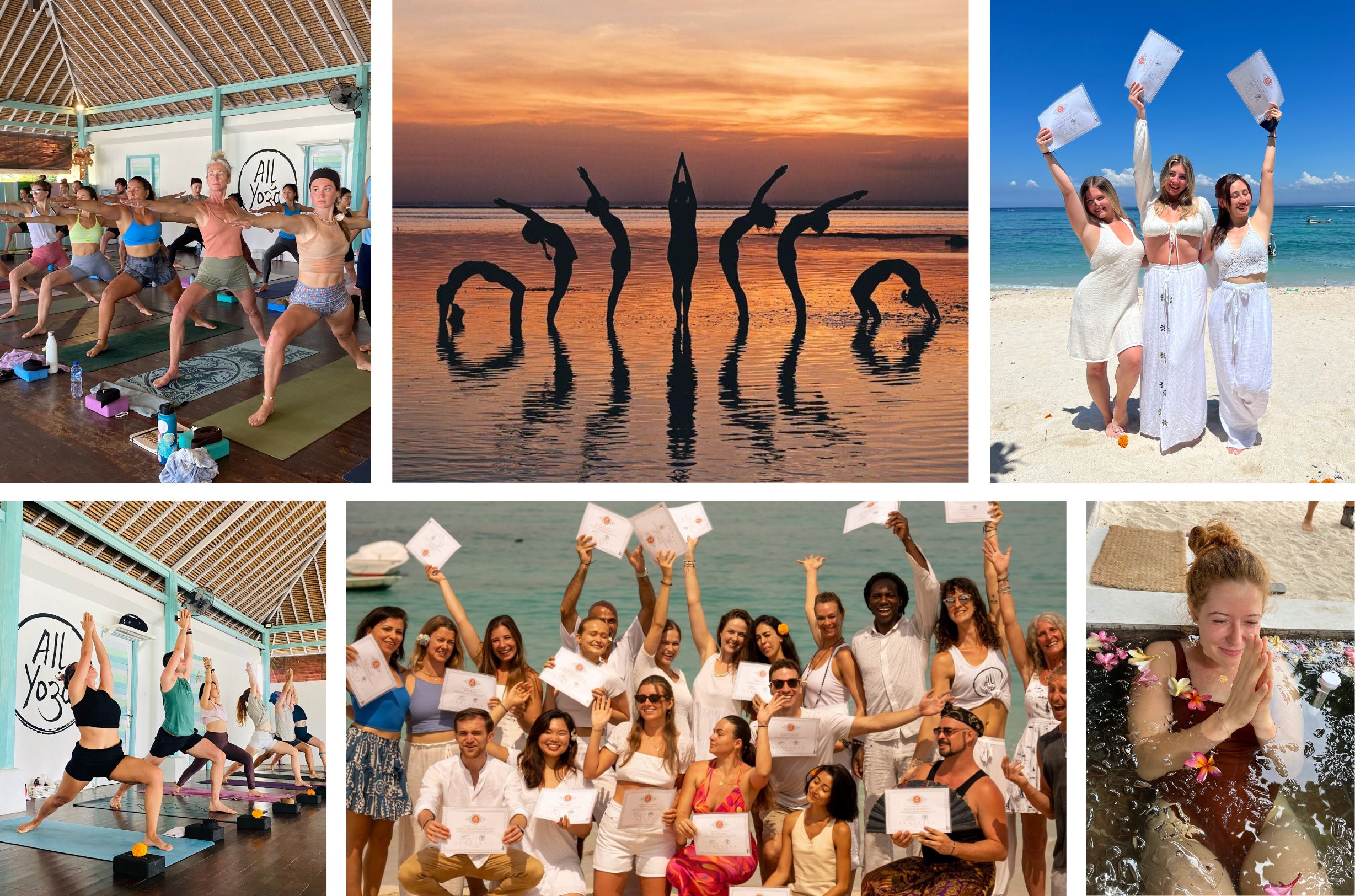
All Yoga runs its Bali training on Nusa Lembongan, a short boat trip from mainland Bali. The course takes 23 days, and each group is capped at 24. Ashtanga Vinyasa provides the backbone, with additional work in Rocket, sequencing, anatomy, philosophy and teaching methodology. The school’s figure of more than 3,500 graduates since 2009 is self-reported.
Program overview and who it suits
I’d put this on the shortlist for someone who already enjoys a dynamic practice and wants to leave ready to lead a room. There’s a lot of hands-on work: explaining postures, building sequences, learning to cue and practicing in front of other students. It is physically demanding, and you do need to plan the extra transfer to the island. If you’re looking mainly for Yin or a slower Hatha training, another course may be a closer fit. For alternatives on the same island, see our Bali yoga teacher training comparison.
- Clear Ashtanga Vinyasa structure
- Published group cap of 24
- Repeated teaching practice, not only lectures
- Long days with vigorous asana practice
- Boat transfer needed
- Not a specialist Yin certification
All Yoga Training Thailand
A smaller group in Phuket, with the same practical Ashtanga emphasis
School overview
All Yoga’s Thailand course is in Phuket, on Panwa Beach. It’s not the Koh Phangan location some older articles still mention. The 23-day training follows an Ashtanga Vinyasa-led curriculum and has a published maximum of 18 students, making this the smaller of All Yoga’s two Asian cohorts.
Program overview and who it suits
The learning emphasis is similar to Bali: daily movement, anatomy, sequencing and plenty of opportunities to practice teaching and receive feedback. I’d choose between the two on group size, intake dates and travel logistics, not on an invented claim that one campus teaches a better qualification. Phuket is generally easier to reach without a separate island boat transfer. Our Phuket yoga teacher training guide compares other schools in the area if you want more local options.
- Smaller published cap than Bali
- Practical teaching emphasis
- Phuket airport access
- Physically intensive syllabus
- Early-bird pricing is conditional
- Not a slow-paced restorative retreat
Ulu Yoga
Four-week Bali course with a Hatha/Vinyasa core and an elective week

School overview
Ulu Yoga runs a 28-day, fully in-person 200-hour training near Bingin Beach in Uluwatu. The listing sets aside roughly three weeks for Hatha and Vinyasa, then one week for an elective such as Yin, Aerial or Ashtanga. That’s a more varied approach than a single-lineage course.
Program overview and who it suits
This is the one I’d compare if you want exposure to different styles before deciding where to specialize. The 28-day version doesn’t require online hours, unlike Ulu’s shorter hybrid programs. Make sure you’re looking at the correct version when you compare prices or teaching hours: they’re not interchangeable. The linked BookRetreats listing currently shows a promotional price; check availability for your intake.
- Genuine 28-day onsite format
- Choice of specialist elective
- Clear distinction from shorter hybrid versions
- Less depth in any single style
- Promotional pricing can change
- Confirm the teaching team for your intake
Samasti Yoga
Functional anatomy and somatic movement rather than another generic flow course
School overview
Samasti’s 29-day Bali training is a different proposition. It puts functional anatomy, body awareness and somatic movement alongside a Hatha and creative-flow foundation. The program names physiotherapist Sean Goldberg among its teaching team, and the published maximum group size is 20.
Program overview and who it suits
What catches my attention is the specificity of the practicum. The listing describes two full one-hour classes with individual feedback, plus teaching work throughout the training. Ask what shorter teaching exercises are included as well. Also check the room option carefully: the lowest advertised fee is tuition-only, not the fully residential package.
- Clear anatomy and movement focus
- Two described hour-long teaching practicums
- Tuition-only and residential options
- Less suitable for a strict Ashtanga syllabus
- Room and meal upgrades add cost
- Strong self-inquiry emphasis won’t suit everyone
Path of Yoga
A 26-day residential course near Chiang Mai with teachers living onsite
School overview
Path of Yoga’s 26-day training is based near Chiang Mai at Mala Dhara. The advertised shared-dorm early-bird fee includes 25 nights, three meals a day and the training itself. The course combines traditional Hatha and Vinyasa with movement science and a residential daily rhythm.
Program overview and who it suits
This would be a strong alternative to island life. The teachers stay at the retreat center with students, and the published syllabus includes regular live teaching practice. The catch is that Path of Yoga also runs a much shorter hybrid program. The BookRetreats link here is for the 26-day residential course, so compare that one with other month-long immersions.
- Accommodation and meals included in the entry package
- Residential access to teachers
- Specific teaching-practice component
- Early-bird dorm pricing has conditions
- Room upgrades add cost
- A northern retreat, not a beach setting
Rishikesh Yog Kendra
A traditional 22-day ashram-style option with one of the lowest shared-room prices
School overview
Rishikesh Yog Kendra lists a 22-day, 200-hour training near Laxman Jhula in Rishikesh. The advertised USD 900 entry fee is for a four-person shared room. Meals, training materials and accommodation are included in the listed package, with smaller rooms costing more.
Program overview and who it suits
For someone who wants the traditional routine, this is more relevant than another beach resort. The schedule includes early starts, Hatha and Ashtanga classes, pranayama, philosophy, anatomy and a teaching practicum. Four people sharing a room won’t suit everyone, though. Check future intake availability and exactly how assessment and supervised class delivery work before paying.
- Low advertised shared-room entry price
- Meals and residential stay in the package
- Traditional philosophy and breathing practice
- Lowest price means a four-person room
- Strict timetable may feel intense
- Check current dates and room availability
Nepal Yoga Home
A three-week residential course for those who want meditation as well as asana
School overview
Nepal Yoga Home advertises a 21-day, 200-hour residential training near Kathmandu. Its shared-room package starts at USD 1,400 and includes tuition, lodging and food. The curriculum covers asana, breathwork, meditation, philosophy, anatomy and teaching practice.
Program overview and who it suits
I’d consider this for students who want a traditional daily routine without the Bali or Phuket price tag. It’s a condensed three-week schedule, so look carefully at the teaching timetable rather than judging it by the certificate alone. The exact venue, season and room category are worth checking before you book flights.
- Published entry package with food and room
- Strong meditation and traditional-study emphasis
- A distinct Himalayan setting
- Intensive 21-day timetable
- Group size is not clearly fixed
- Travel and seasonal weather need planning
Senses Yoga Teacher Training
A small-group Vinyasa and Yin course on Sri Lanka’s south coast
School overview
Senses runs a 22-day 200-hour Vinyasa and Yin training on a fruit farm near Ahangama. The BookRetreats listing names four senior teachers, a group range of two to fourteen trainees, 21 nights’ accommodation and two meals a day. It’s a different offer from a hybrid course with most of its work done online.
Program overview and who it suits
For me, the draw is the combination of a small group and a recognizable Vinyasa/Yin curriculum. The school also advertises post-course mentoring. I’d ask how much of that mentoring is scheduled versus optional, and exactly how many classes each trainee gets to lead. At this price, the details matter more than the fruit-farm setting.
- Published small-group range
- Vinyasa and Yin together
- Accommodation and two meals included
- Higher advertised entry fee
- Not primarily an Ashtanga course
- Clarify assessment and mentoring arrangements
Shiva Flow Vietnam
A 24-day Hatha and Ashtanga program in Ho Chi Minh City
School overview
Shivaay Shakti Yogashala (also called Shiva Flow) lists a 24-day, 200-hour training in Ho Chi Minh City. It follows a Hatha and Ashtanga foundation and publishes a group range of five to ten students. This is a city-based option, not an isolated beach or mountain retreat.
Program overview and who it suits
It makes practical sense for someone already traveling in Vietnam who wants a residential course with a traditional syllabus. The BookRetreats listing specifies 23 nights and an advertised fee from USD 2,400. Check the exact location, meals and class timetable for your chosen dates; urban courses can vary significantly in their daily rhythm.
- Vietnam option with a named course listing
- Small published group range
- 24-day format rather than a short hybrid
- City location won’t suit retreat seekers
- Confirm the room and meal package
- Less of a contemporary Vinyasa specialty
Best countries in Asia for yoga teacher training
A country name tells you surprisingly little about the day-to-day training. Nusa Lembongan and Canggu don’t feel the same, and neither do Phuket and Chiang Mai. Here’s the practical distinction.
| Country | Common training hubs | Best for | Trade-off |
|---|---|---|---|
| Indonesia (Bali) | Nusa Lembongan, Uluwatu, Canggu, Ubud | Immersive Vinyasa and multi-style training with an international yoga scene | Popular hubs can be expensive; islands may require boat transfers |
| Thailand | Phuket, Chiang Mai, Koh Phangan | Beachfront or northern retreat settings, varied residential formats | Very different locations under one country label; check the actual campus |
| India | Rishikesh, Goa, Mysore | Traditional Hatha, philosophy, pranayama and ashram-style study | Intensity and accommodation standards vary widely |
| Nepal | Kathmandu Valley | Traditional immersion, meditation and lower advertised package costs | Weather, transfers and travel conditions need planning |
| Sri Lanka | Ahangama, Talalla, Kalpitiya | Coastal residential programs, including Vinyasa/Yin training | Check whether the course is entirely in person or includes online study |
| Vietnam | Ho Chi Minh City | Urban access to yoga schools and flexible living arrangements | Less of the secluded retreat experience many trainees seek |
If you’ve narrowed it down to one country but not a school, we have more detailed comparisons for
yoga teacher training in Thailand, yoga teacher training in India. They cover more choices than this Asia-wide shortlist.
Bali or Thailand for All Yoga? Bali means training on Nusa Lembongan, with a maximum cohort of 24 and a boat journey to reach the island. Thailand means Panwa Beach, Phuket, and a published cap of 18. The curriculum is similar; your decision is really about the intake dates, group size, travel route and overall cost. See Bali or see Phuket.
How much does a 200-hour yoga teacher training in Asia cost?
The headline price is rarely the whole bill. Rishikesh Yog Kendra advertises a four-share residential option from USD 900. Samasti’s lowest price is tuition-only. All Yoga’s fees and accommodation offers depend on the intake. Add the room you actually want, meals, travel, transfers, insurance and any extra nights before comparing them.
- Ask which room the price buys. A four-person share and a private room are very different budgets.
- Separate onsite hours from online work. A 14-day hybrid course isn’t a 28-day, fully in-person course.
- Check the meal plan. Some packages include three meals a day; others include two, or none.
- Get the booking terms in writing. Deposits, refunds, assessments and transfers can all change the cost.
- Leave room in the budget. Flights, visas, insurance and transfer days add up.
If budget comes first, investigate residential options in India or Nepal. If your priority is to teach dynamic, Ashtanga Vinyasa-led classes, compare the teaching hours and practical work on All Yoga’s Bali and Phuket courses. Paying less only helps if you get the training you wanted. Our affordable yoga teacher training comparison is useful if you’re working to a tighter budget.
200-hour certification: what to check before booking
A 200-hour certificate is a starting qualification, not an automatic membership card for every professional body. Our Yoga Alliance certification guide explains the difference between a school’s registration and a graduate’s RYT 200 registration. If Yoga Alliance registration matters to you, check the school’s current status and what graduates must do to apply for RYT 200. Employers and insurers may also have local requirements.
Ask for a proper outline of your intake: the actual teachers, the classroom hours, online assignments, assessment and supervised teaching. You can verify a school’s Registered Yoga School status through the Yoga Alliance directory, rather than relying on a badge on a sales page.
- Who will teach anatomy, philosophy and the practical modules on my actual intake?
- How many complete classes will I lead, and who will give me individual feedback?
- How many hours are online, live online, in person and independent study?
- What is the maximum group size and the usual teacher-to-trainee ratio?
- Which expenses are excluded from the advertised price and what happens if I need to cancel?
Frequently asked questions about yoga teacher training in Asia
Which country in Asia is best for yoga teacher training?
India is worth looking at for traditional Hatha, pranayama and philosophy. Bali and Thailand give you more beachfront and residential Vinyasa options; Nepal is appealing if meditation is part of your main goal. Sri Lanka has strong small-group coastal courses, and Vietnam offers city-based training. Compare programs, not just countries.
Can beginners join a 200-hour yoga teacher training in Asia?
Many schools accept committed beginners, but a 200-hour intensive can mean long days of practice and study. Check the required experience, physical demands and how teachers adapt poses for injuries or limited mobility. Don’t assume ‘beginner-friendly’ means easy. If you’re considering an intensive, read our yoga teacher training preparation guide before you book.
How long does a 200-hour yoga teacher training take in Asia?
The in-person courses in this shortlist range from roughly three to four weeks. Some other 200-hour courses require only 10 or 14 days onsite because the remaining study happens online. Ask the provider for an hour-by-hour breakdown before you compare durations.
Is yoga teacher training in India cheaper than Bali?
It can be. For example, Rishikesh Yog Kendra advertises a four-person room package from USD 900, below several Bali course prices. That doesn’t mean the packages are equivalent: compare the accommodation, meals, curriculum and practice-teaching hours.
Can I teach yoga after completing a 200-hour course in Asia?
A good foundation course should prepare you to start teaching at an appropriate level. You still need to check employer, insurer and professional-body requirements in the country where you’ll work. A 200-hour certificate doesn’t automatically register you as RYT 200.
What’s the difference between a residential and hybrid teacher training?
Residential means you live at or near the training venue during the in-person course. Hybrid divides the curriculum between onsite and online study. Neither tells you how much time you’ll personally spend teaching, so ask for the supervised practicum hours. See how our hybrid 200-hour training in Bali splits theory and practical work, or compare online yoga teacher training programs if you can’t travel.
Does All Yoga Training run its Thailand course on Koh Phangan?
Not currently. The Thailand 200-hour course is based at Panwa Beach in Phuket. Some older pages still mention Koh Phangan, which is why it’s worth checking the current program before booking travel.
How do I compare yoga teacher training prices fairly?
Pick the dates and room type you’d actually book. Then put tuition, meals, transfers, taxes, deposit terms and cancellation rules on the same sheet. Add flights, insurance and personal expenses. The lowest ‘from’ price isn’t necessarily the cheapest trip.
Should I choose Bali or Thailand for All Yoga Training?
Choose Nusa Lembongan if you want the quieter island setting and don’t mind a boat transfer. Phuket has a smaller published cap of 18 and a simpler airport transfer. Both offer a 23-day, Ashtanga Vinyasa-led course; availability and total cost may decide it for you.
Our take: choose the training before the destination
If your aim is to learn to teach dynamic yoga in person, our Bali and Phuket courses are the natural place to begin. We run them, so don’t take that recommendation as an independent verdict. Compare their course structure with the alternatives above, then choose the program you can realistically commit to. Already have your 200-hour certification? Our 300-hour advanced yoga teacher training is the more relevant next step.
For a traditional residential routine, compare Rishikesh Yog Kendra and Nepal Yoga Home. Ulu Yoga gives you specialist electives, Samasti goes deeper on functional anatomy, and Senses pairs Vinyasa with Yin in Sri Lanka. The detail I’d ask every school for is the same: how much will I actually teach, who gives me feedback, and what will I pay in total?
Compare All Yoga dates and fees →
| Explore all All Yoga programs →
The post The 9 Best Yoga Teacher Training in Asia in 2026 appeared first on All Yoga Training.